
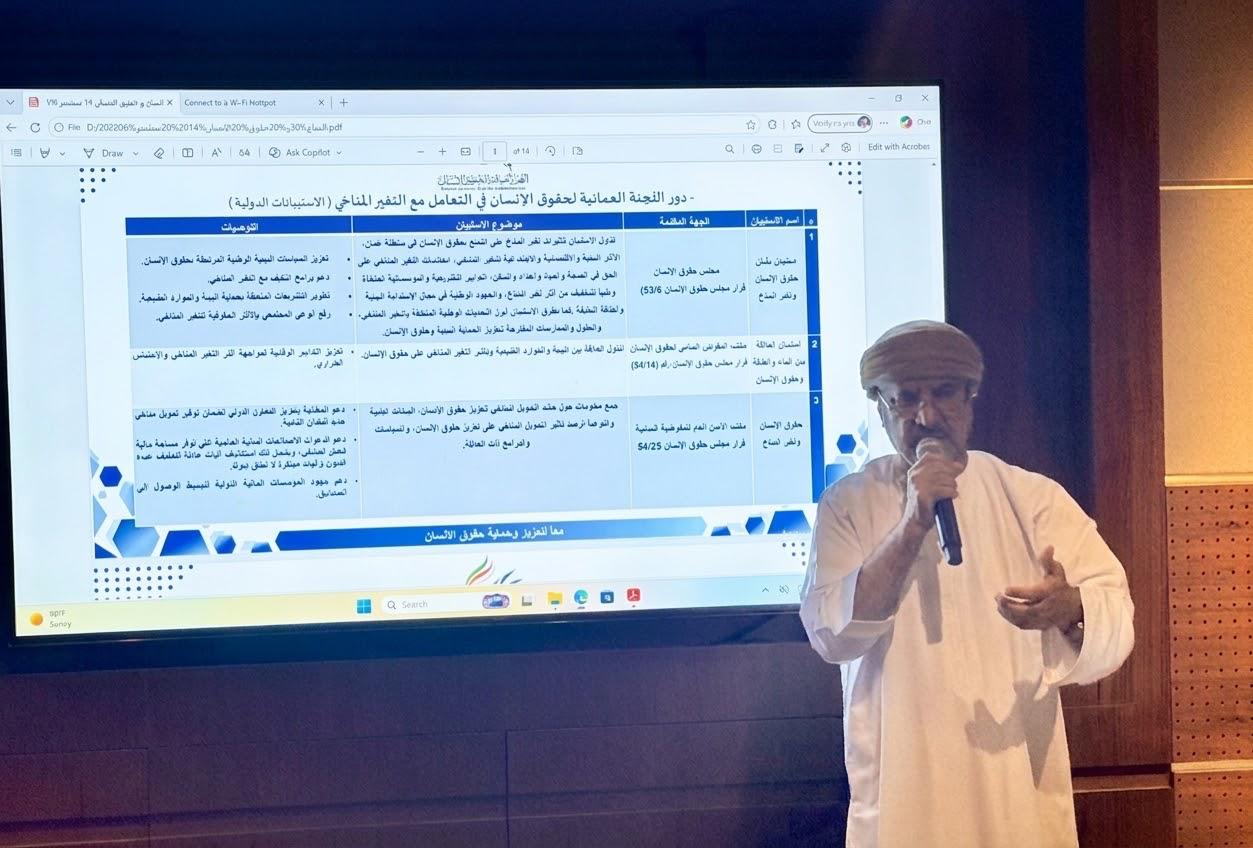

He made these remarks while presenting a working paper during Oman Climate Week. The paper reviewed the legal and institutional framework in the Sultanate of Oman for protecting the environment and addressing the impacts of climate change. It also highlighted the alignment of these national efforts with the priorities of Oman Vision 2040, particularly the sustainable environment priority.
The paper further discussed the key rights affected by climate change, highlighting the groups most vulnerable to its impacts and the importance of adopting a human rights-based approach when formulating climate adaptation and response policies.
In outlining the practical role of the Oman Human Rights Commission, Professor Al-Balushi referred to the Commission’s direct intervention following an oil spill involving an oil tanker. He explained that a specialised team from the Commission conducted a field visit to the affected area to closely examine the government’s efforts to mitigate any adverse impacts on the environment and local communities. Alongside its fieldwork, the Commission intensified its awareness-raising efforts by publishing a series of educational bulletins on its website and social media platforms to raise public awareness of the incident and its environmental and human rights implications.
The presentation also highlighted the Commission’s ongoing role in addressing environmental and human rights issues through monitoring, receiving reports and complaints, participating in international conferences, responding to United Nations questionnaires, and contributing to relevant national studies and partnerships.